Why I Wrote The New Manager’s Action Workbook
By Nancy Patrick | KBI Digital
You’ve built the reports, solved the problems, and become someone your team relies on. Then you step into management, and the questions change.
How do you lead people who used to be your peers? What should you ask in your first one-on-one? How do you help someone finish an assignment without taking it over? And how do you make time for your new responsibilities when everyone still comes to you for technical answers?
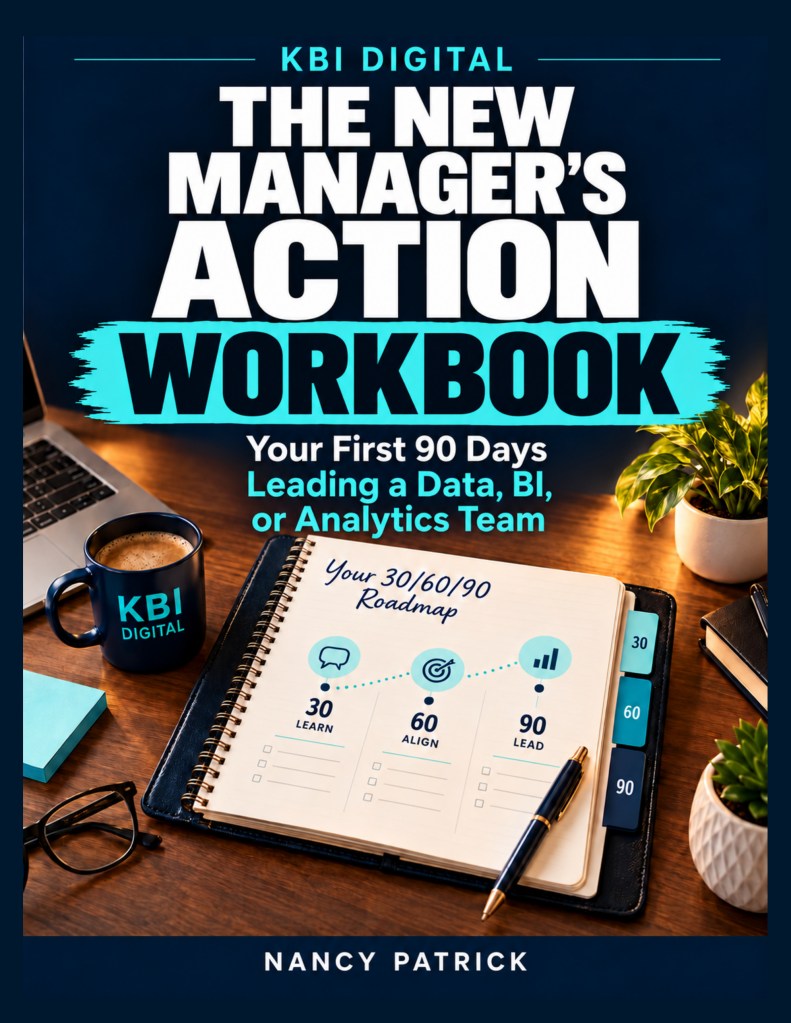
Those are the everyday situations behind my newest book, The New Manager’s Action Workbook: Your First 90 Days Leading a Data, BI, or Analytics Team.
I wrote it to give new managers somewhere practical to begin.
Why I wrote this book
Over my 25 years in analytics, including a decade of remote leadership, I’ve learned that knowing the work and helping a team succeed at the work require different skills.
Technical experience helps you recognize a questionable number, understand a reporting dependency, or ask a useful question about a query. But management also asks you to clarify expectations, make choices about priorities, develop people, and follow through on difficult conversations.
It can be tempting to keep doing the things that made you successful before the promotion. Fix the dashboard yourself. Rewrite the query. Finish the report because explaining what needs to change feels slower.
Sometimes direct help is appropriate. But when taking over becomes your usual response, your own responsibilities pile up, and your team loses opportunities to develop confidence and judgment.
I wanted to write a book that helps new managers recognize those moments and choose what to do next.
That means sharing practical lessons from experience, including mistakes and the things I wish I had understood sooner. It also means acknowledging that you can care about your team, know your field, and still need help finding the words for a conversation.
Who this workbook will help
I created this book for people stepping into leadership in data, business intelligence, and analytics.
You might be an analyst promoted to manage your former teammates. You might be a new BI manager responsible for competing reporting requests. Or you might be leading an analytics team for the first time and discovering how much of the job involves expectations, relationships, and decisions.
The book can also help if you’ve been managing for a while but want to revisit your foundation. Perhaps your one-on-ones have become status updates, delegation keeps turning into rescue work, or you and your boss need a clearer agreement about priorities.
Experienced managers and mentors can use the exercises as a starting point for conversations with someone they’re helping develop.
The examples come from analytics work, where a report can be delivered on time and still fail to answer the business question. The management lessons focus on making those expectations clear before people invest their time.
Why I made it a workbook
Reading advice is useful. Applying it to a conversation you need to have tomorrow is where it becomes valuable.
I wanted readers to have room to think through their own situations: what they know, what they still need to understand, and what they will do next.
Throughout the book, you’ll follow Maya, a fictional analyst who has just become manager of an eight-person analytics team. She faces competing stakeholder requests, unclear assignments, changing relationships, and the urge to keep solving everything herself.
Her experiences introduce the management challenge. The exercises then bring it back to your work.
Completed examples show how the worksheets can be used, so you have a starting point when you turn to your own situation. You’ll also find “Say it this way” scripts to help you prepare for conversations without having to invent every opening sentence.
You can adapt the wording to sound like you. The purpose is to help you begin with more clarity.
What you’ll work on
The workbook follows the first 90 days while leaving room for the reality that management needs rarely arrive in chapter order.
Start with a clear foundation. Understand your responsibilities, confirm your boss’s priorities, and prepare your first conversations. A 10-minute quick start helps you choose and schedule your next actions.
Listen and build trust. Learn what your team needs, understand how work gets done, and follow through on the commitments you make. Pay attention to how relationships change when you become the manager.
Create clarity and consistency. Make assignments easier to understand, give meetings a clear purpose, and choose improvements that fit the team’s capacity.
Strengthen everyday people skills. Practice delegation, feedback, and difficult conversations. These skills matter from the beginning, so you can turn to them whenever the need appears.
Sustain progress and review. Look at what has changed, what still needs attention, and what you want to carry into your next 90 days.
Tools you can bring into your work
Inside the book, you’ll find:
- A 30/60/90-day leadership plan to connect priorities, actions, and evidence of progress.
- Boss alignment and clear-expectations worksheets to help people agree on what success means.
- First-conversation and recurring one-on-one agendas to make room for concerns, feedback, and development.
- Delegation agreements and feedback planners to help you prepare and follow through.
- Difficult-conversation and team-conflict tools to organize the facts and questions before you respond.
- Request intake and delivery checks to clarify ownership, metric definitions, data sources, deadlines, and quality expectations.
Printable companion worksheets are available for repeated use.
The tools support the work of management: having the conversation, making the decision, checking understanding, and returning to the agreement when something changes.
A familiar analytics problem—and a management lesson
Consider an assignment as simple as, “Get the sales dashboard ready this week.”
The analyst improves the layout. The manager expected the numbers to be checked, the date range corrected, and the treatment of returns aligned with finance.
Both people thought the request was clear. They had different definitions of “ready.”
That is the kind of situation this workbook explores. Before assuming someone needs more motivation or closer supervision, a manager can ask whether the outcome, quality standard, ownership, and deadline were actually understood.
A clearer agreement at the beginning can prevent frustration and rework later.
The same thinking applies when a stakeholder asks for another urgent report, a team member hesitates to raise a concern, or two colleagues disagree about data quality. Understanding the problem helps you choose a useful response.
You don’t have to wait until you feel ready
One message I hope readers take from this book is that management develops through practice.
You can prepare for a conversation while still feeling nervous. You can ask your boss to clarify a priority. You can recognize that an assignment was unclear and reset the agreement. You can try a different approach when your first attempt doesn’t work.
The first 90 days give you a useful period to focus your attention. They don’t create a deadline for having everything figured out.
If you’re already past day 90, begin with the situation in front of you. Choose one conversation to prepare for, one expectation to clarify, or one commitment to follow through on.
That is why I wrote The New Manager’s Action Workbook: to help you turn the responsibility of a new role into practical steps you can take.
The New Manager’s Action Workbook is now available on Amazon in paperback and Kindle.
What do you wish someone had explained before your first management role? Share it in the comments—or tell me which conversation you’re preparing for now.
Nancy Patrick is the author behind KBI Digital. Drawing on 25 years in analytics and a decade of remote leadership, she shares practical tools and lessons to help people work smarter and lead with greater clarity.


Leave a Reply